Factory Direct
 Quality Guaranteed
 Hassle-Free Delivery
 After-Sales Guarantee
Product Introduction
Overview
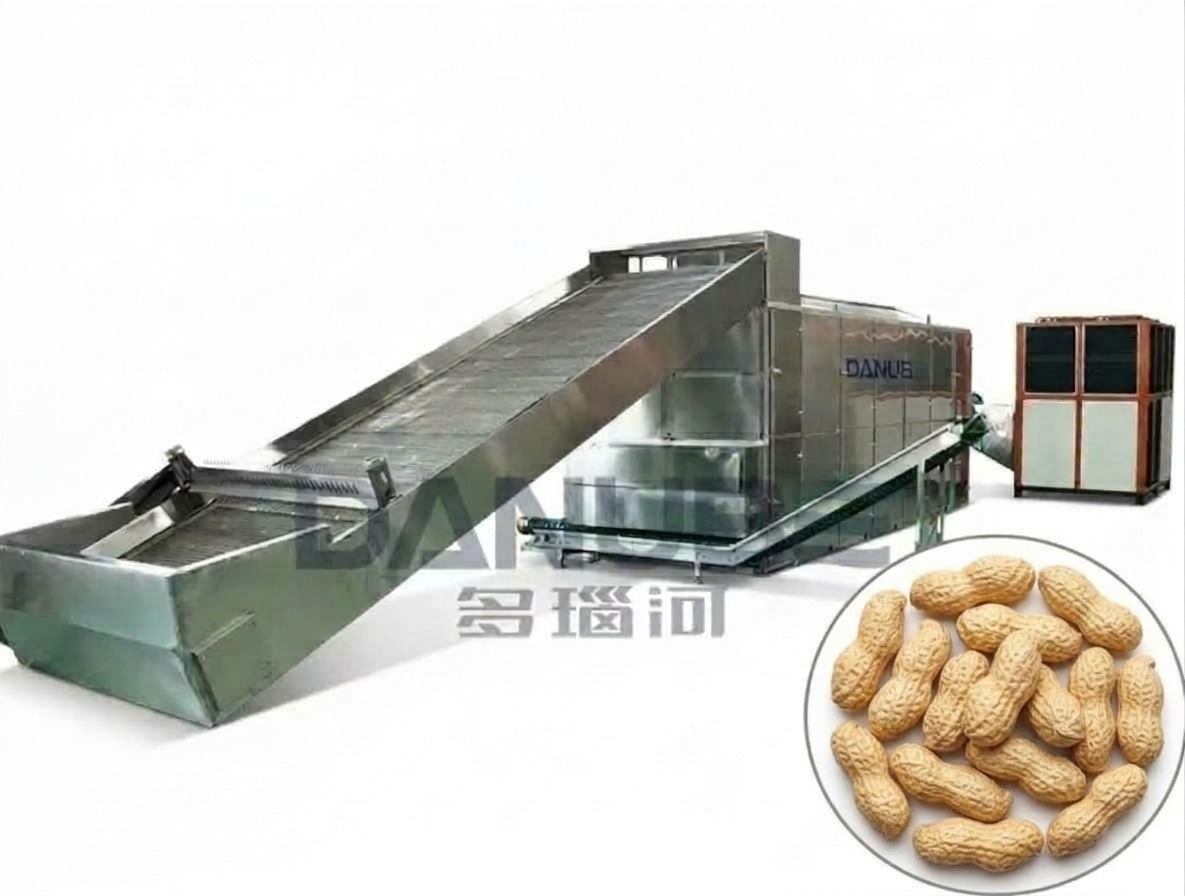
DANUBE provides continuous industrial peanut dryers for commercial peanut processing. Using a mesh belt conveyor and circulating hot air, the machine removes moisture as peanuts pass through the drying chamber. It can be configured for suitable in-shell peanuts and shelled peanut kernels, with adjustable conveyor speed, drying temperature, and equipment dimensions to meet different material characteristics, moisture requirements, and production capacities.
Key Components of the Peanut Drying System
Feeding System: Distributes peanuts across the belt for consistent material loading.
Mesh Belt Conveyor: Moves peanuts through the drying chamber at an adjustable speed.
Hot-Air Circulation System: Circulates heated air through the material layer to support moisture removal.
Heating System: Can be configured with a suitable heat source according to the selected model and local energy conditions.
Temperature Control System: Allows operators to adjust drying temperature according to material and process requirements.
Moisture Exhaust System: Discharges moisture-laden air from the drying chamber.
Continuous Peanut Drying Process
Raw Peanuts → Cleaning → Optional Shelling and Grading → Feeding → Mesh Belt Drying → Cooling → Storage or Packaging
The actual process depends on whether peanuts are dried with the shell or as kernels, as well as the requirements of subsequent processing.
Key Advantages of the Continuous Industrial Peanut Dryer
High-Efficiency Continuous Operation: Designed for non-stop feeding and automatic discharge, significantly boosting daily throughput for commercial peanut processing.
Uniform Drying & Quality Preservation: Advanced multi-zone temperature control and balanced airflow ensure uniform moisture removal without shell cracking or kernel scorching.
Customizable & Flexible Design: Modular configurations with adaptable belt widths, drying tunnel lengths, deck layers, and heating options (steam, gas, electric, or heat pump).
Food-Grade Hygiene & Easy Maintenance: Features SUS304 stainless steel contact surfaces and convenient access doors for quick cleaning and sanitation compliance.
Automated Labor Savings & Line Integration: Minimizes manual material handling and connects seamlessly with upstream cleaning/sorting and downstream cooling/packaging equipment.
Peanut Drying Applications
The industrial peanut dryer can be evaluated for the following applications:
In-Shell Peanut Drying: Moisture reduction for suitable whole peanuts, depending on shell condition and processing requirements.
Peanut Kernel Drying: Drying shelled kernels before storage or further processing.
Peanuts for Further Processing: Moisture conditioning of suitable peanut materials before roasting, frying, grinding, or ingredient production.
The appropriate drying conditions depend on the peanut variety, material form, initial moisture content, target moisture level, and final product requirements.
Technical Parameters
| Parameter | Reference Specification |
|---|---|
| Equipment Type | Continuous Mesh Belt Dryer |
| Operating Temperature | 40–120°C |
| Reference Drying Time | 0.5–5 hours |
| Reference Material Layer Thickness | 50–200 mm |
| Reference Equipment Sizes | 6 × 2 × 2.5 m; 9 × 2 × 2.5 m; 12 × 2 × 2.5 m |
| Reference Capacity | 200–1,500 kg/h, depending on model |
| Heating Options | Electric, gas, solid fuel, or steam, subject to configuration |
| Belt Material | Stainless steel; SUS304 available for applicable food-contact components |
| Customization | Dimensions, belt configuration, heating method, and conveyor speed |
Note: Reference capacities are not guaranteed peanut-specific outputs. Final specifications depend on peanut type, initial and target moisture content, material loading, and drying conditions.
Frequently Asked Questions
1. What is the capacity of an industrial peanut dryer?
Capacity depends on the peanut type, moisture removal requirements, and selected dryer model. The mesh belt dryer range offers different configurations for commercial production.
2. How long does it take to dry peanuts?
Drying time depends on the initial moisture content, target moisture level, peanut size, and drying conditions. The actual time should be determined according to the material and process requirements.
3. Can the peanut dryer be integrated into a complete processing line?
Yes. It can be integrated with suitable cleaning, grading, cooling, conveying, and packaging equipment according to your production process.
4. What information is needed for a quotation?
Please provide the peanut type, processing capacity, initial and target moisture content, and available heat source. Photos or material samples can also help with equipment selection.
Request a Continuous Peanut Drying Solution
Contact us with your peanut type, moisture requirements, and target production capacity. We can evaluate a suitable mesh belt drying configuration for your processing line.