 Factory Direct
 Quality Guaranteed
 Hassle-Free Delivery
 After-Sales Guarantee
Product Introduction
Vacuum Freeze Drying Overview and Process
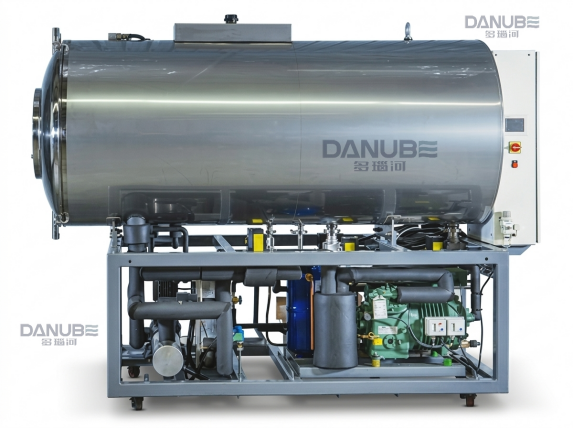
Industrial-grade vacuum freeze dryer designed for batch and continuous dehydration of food, agricultural, and heat-sensitive products. It uses low-temperature sublimation to remove moisture while helping preserve the original color, structure, flavor, texture, and heat-sensitive components of the product.
Typical Process: Material Preparation → Freezing → Primary Drying → Secondary Drying → Product Unloading
1. Freezing: The material is frozen to prepare the water for sublimation.
2. Primary Drying: Most of the frozen water is removed as ice sublimates directly into vapor.
3. Secondary Drying: Remaining moisture is further removed to achieve the required final moisture level.
The drying cycle can be adjusted according to the material, moisture content, product structure, and required final quality. Capacity and equipment configuration can also be customized according to production requirements.
Main Components
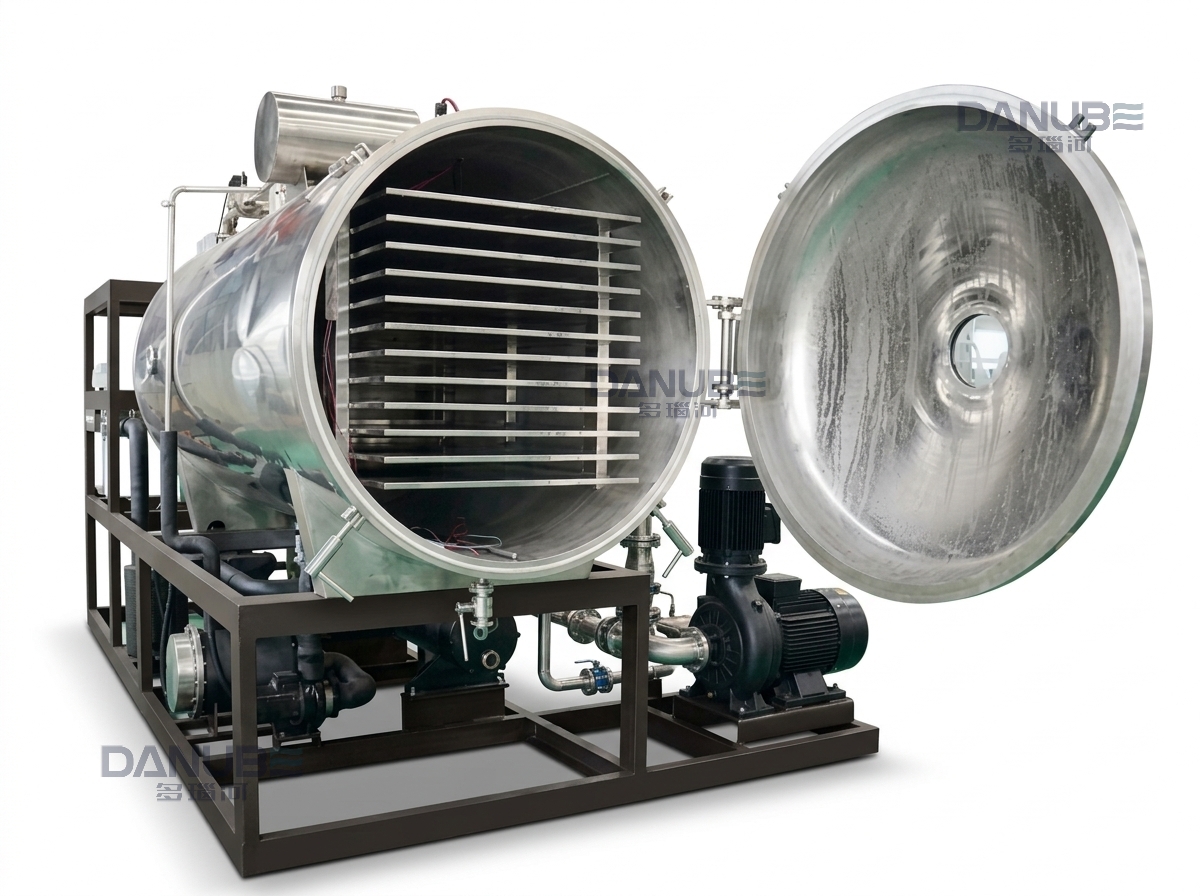
The complete system can be configured with the following major components:
1 . Vacuum Drying Chamber— Provides a controlled environment for the drying process.
2. Material Shelves and Trays— Hold the product during freezing and drying.
3. Refrigeration System— Provides the low temperature required for product freezing and vapor condensation.
4. Vacuum System— Creates and maintains the required vacuum inside the chamber.
5. Condenser System— Captures water vapor released during sublimation.
6. Heating and Control System— Provides controlled shelf heating and manages key drying parameters.
Key Features
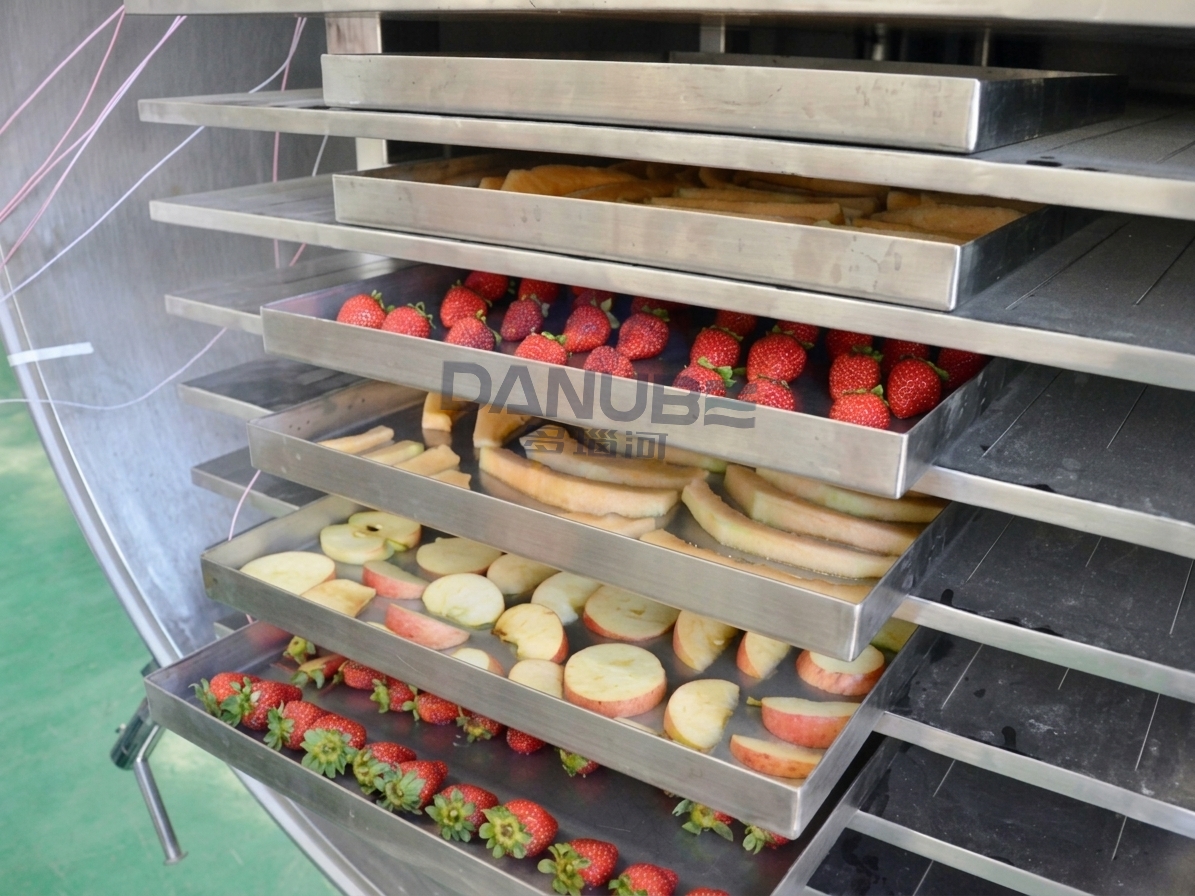
1. Precise Temperature Control: The control system allows the drying temperature to be adjusted according to the material and drying requirements.
2. Nutrient & Structure Retention: Freeze drying at low temperatures helps minimize shrinkage and maintain a porous product structure, supporting good rehydration performance.
3. Sanitary Stainless Steel Chamber: Heavy-duty stainless steel vacuum chamber with mirror-polished interior, designed for easy cleaning and suitable for food and pharmaceutical applications.
4. Energy-Efficient Refrigeration & Vapor Condensation: High-capacity condenser design ensures rapid ice trapping and reduced power consumption during long drying cycles.
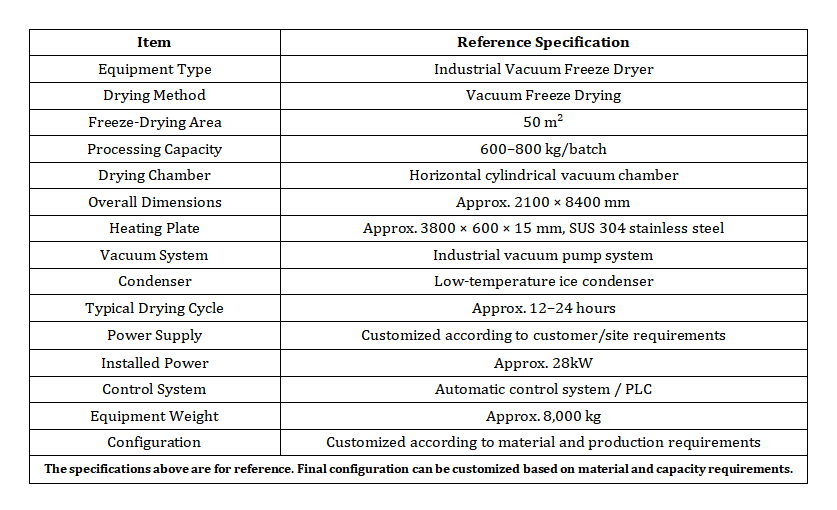
Vacuum Freeze Dryer – Technical Parameters
Freeze Drying Equipment Options
We provide different types of freeze drying equipment for different applications, production scales and product requirements.
1. Freeze Drying Test Machine:Designed for laboratory testing, product development and process evaluation before larger-scale production.
2. General Freeze Dryer:Suitable for general freeze-drying applications where flexible batch processing is required.
3. Continuous Freeze Dryer:Designed for continuous industrial processing where the production process and product characteristics are suitable for continuous operation.
4. Food Freeze Dryer:Configured for food and agricultural products such as fruits, vegetables, meat and other suitable food materials.
5. Pharmaceutical Freeze Dryer:Designed for pharmaceutical and other heat-sensitive applications. The actual configuration and compliance requirements depend on the specific product and project.
6. Large Freeze Dryer:Designed for larger production requirements with greater drying capacity and drying area.
Suitable Materials
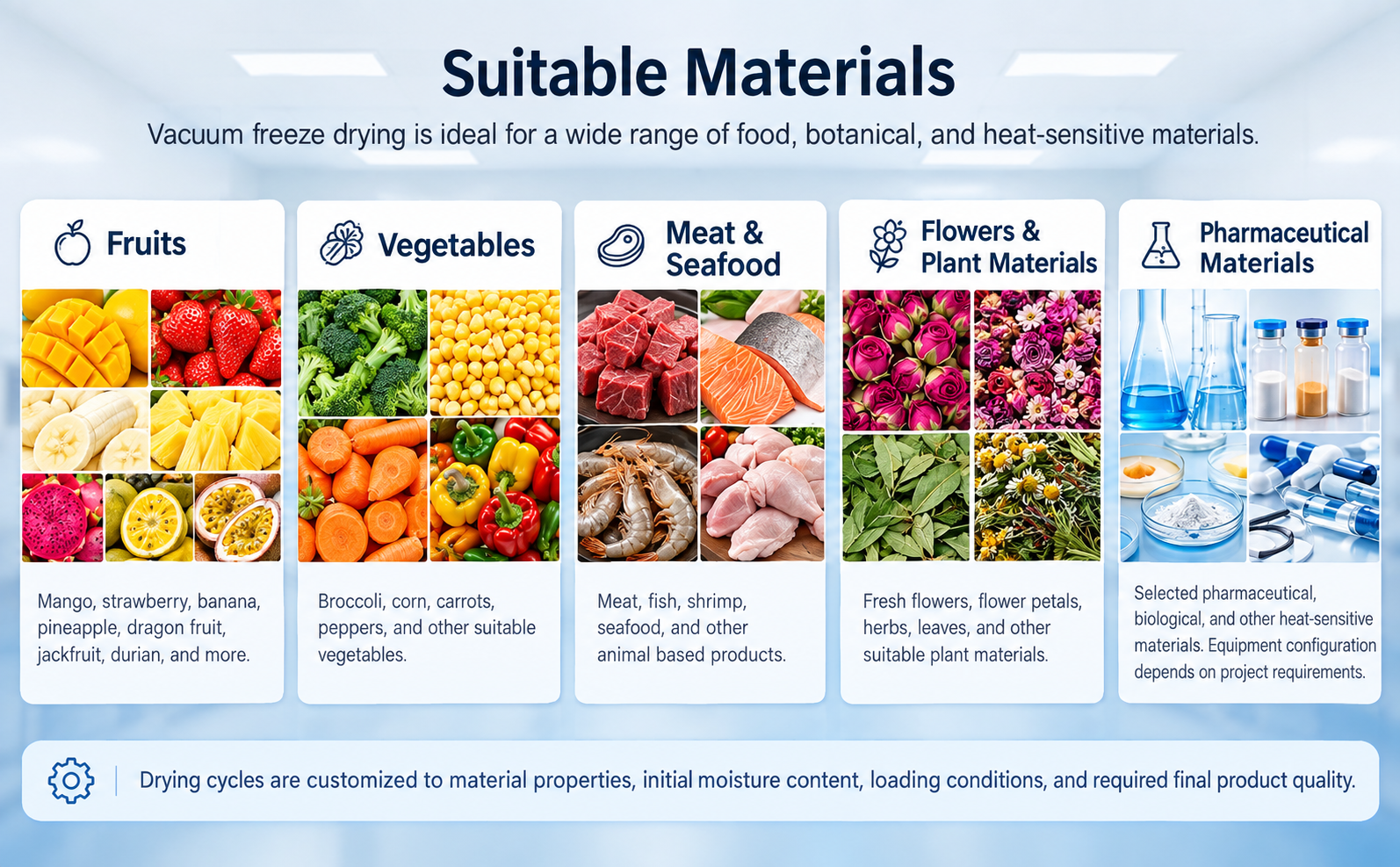
1. Fruits & Vegetables: Strawberries, durian, mango, apples, corn, mushrooms.
2. Meat & Seafood: Raw pet food, beef, shrimp, chicken, sea cucumber.
3. Nutraceuticals & Pharma: Herbal extracts, probiotics, enzymes, biological powders.
Frequently Asked Questions
1. What is the difference between freeze drying and conventional drying?
Conventional hot-air drying mainly removes moisture through evaporation at elevated temperatures. Freeze drying uses freezing and vacuum sublimation, allowing products to be processed at much lower temperatures and helping preserve their original characteristics.
2. Can the equipment be customized?
Yes. The drying area, batch capacity, refrigeration system, vacuum system, condenser, shelf configuration and control system can be configured according to the product and production requirements.
3. Is freeze drying suitable for every product?
No. Freeze drying is most useful when product quality, structure, appearance or heat-sensitive components are important. The suitability of a specific material should be confirmed through process testing.
4. What information is needed for a quotation?
Please provide the material type, initial moisture, target moisture, required capacity, expected final product and available installation conditions. Sample testing may also be useful for products with specific drying requirements.