Dried chili peppers may turn dark brown, lose their bright red color, or develop uneven patches during processing. For commercial processors, these defects can reduce product value and lead to buyer complaints, even when the batch meets its target moisture content.
The cause is not always excessive temperature. Raw material quality, heat exposure, uneven airflow, drying time, and storage conditions can all affect the final color. Identifying when discoloration occurs is the first step toward improving product consistency.
1. Why Does Dried Chili Turn Black?
Excessive Heat Exposure
Red chili gets much of its color from natural pigments, particularly carotenoids. Heat and oxygen exposure can contribute to pigment degradation, while browning reactions may further darken the product.
High temperatures can accelerate these changes, but prolonged exposure to moderate heat may also affect color. Check the actual drying temperature and compare peppers from different positions. If peppers near the heat inlet are consistently darker, investigate temperature distribution.
Uneven Drying and Airflow
A batch may contain both underdried and overdried peppers even when its average moisture content meets the target. Uneven loading, excessive overlap, or inconsistent airflow can cause different drying rates within the same batch.
In continuous dryers, uneven feeding and variations in material depth across the belt can create similar problems. Some peppers may receive excessive heat while others retain too much moisture.
Poor Raw Material Quality
Bruised, damaged, overripe, or deteriorating peppers may already have poor color before drying begins. Different varieties and maturity levels can also respond differently to the same processing conditions.
Sorting damaged peppers and separating significantly different raw material lots can improve consistency, although drying cannot restore color that has already deteriorated.
Improper Cooling and Storage
Chili that looks acceptable at discharge may lose color during storage. Exposure to oxygen, light, elevated temperatures, and moisture can contribute to quality deterioration.
Allow the product to cool appropriately before packaging, and use packaging suitable for the expected storage and distribution conditions.
2. How to Identify the Cause
Use the observed defect as a starting point for troubleshooting. These symptoms suggest possible causes but do not prove them.
| Problem observed | Possible cause | What to check |
|---|---|---|
| Entire batch turns dark | Excessive heat exposure or poor raw material condition | Temperature history, cycle time, incoming material |
| Peppers near the heat inlet are darker | Uneven heat distribution | Temperature and airflow across the chamber |
| Some peppers remain moist while others are dry | Uneven loading or airflow | Loading depth, pepper size, air circulation |
| Drying takes longer than usual | Poor ventilation, high exhaust humidity, or overloading | Exhaust path, airflow, loading rate |
| Color fades during storage | Exposure to light, oxygen, heat, or moisture | Cooling, packaging, storage conditions |
Compare a good batch with a problem batch. Record raw material condition, temperature profile, loading rate, drying time, and final moisture. Change one major operating variable at a time where practical, so the effect of each adjustment can be assessed.
3. How to Prevent Dried Chili from Turning Black
Control Temperature and Drying Time
Choose drying conditions according to the chili variety, initial moisture, product form, and required quality. Lower temperatures do not always produce better results because they may extend the drying cycle.
Published studies can provide useful starting points, but laboratory results should not be treated as universal industrial settings. Validate operating conditions with representative production batches and compare drying time, moisture, and color.
Improve Loading and Airflow Uniformity
Spread peppers evenly and avoid excessive loading. Check for blocked air passages and compare products from different tray levels or belt positions.
Increasing airflow alone may not solve the problem. Temperature, exhaust humidity, loading depth, and drying time need to be considered together.
Monitor Moisture Before Discharge
Do not rely on a fixed drying time alone. Initial moisture, pepper size, loading conditions, and ambient humidity can all affect the required cycle.
Take representative samples from multiple positions and check moisture alongside visible color. Meeting the moisture target does not automatically guarantee uniform color or food safety.
Protect the Product During Storage
Cool dried chili appropriately before packaging and protect it from moisture, direct light, and excessive heat. Packaging should match the product’s moisture level and expected storage conditions.
If black spots, visible mold, or unusual odors appear, isolate the affected product and investigate. Do not treat possible contamination as ordinary color fading.
4. Industrial Chili Drying: A Real Project Example
In Indonesia, DANUBE supplied a continuous drying line for whole red chili peppers, combining an automated feeding conveyor, a multi-layer mesh belt dryer, and an air-source heat pump heating system.
The project addressed several practical challenges, including uneven moisture removal, color control, humid weather, and labor-intensive material handling. The system allows drying conditions, exhaust humidity, and conveyor speed to be adjusted according to production requirements.
Read the full Indonesia Chili Pepper Drying Project to learn more about the equipment configuration and processing application.
5. Which Drying System Is Suitable for Industrial Chili?
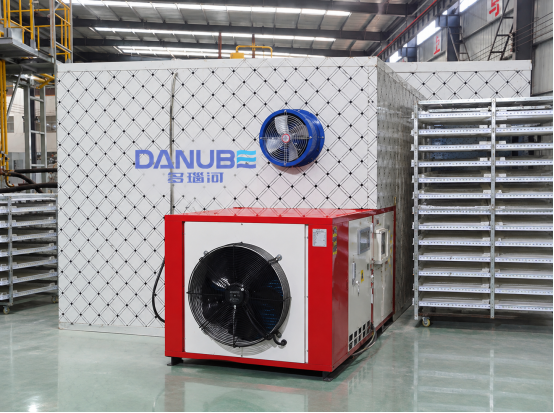
Batch drying rooms and continuous mesh belt dryers can both be used for commercial chili processing. The choice depends on throughput, production scheduling, available space, and process flexibility.
| Factor | Batch drying room | Mesh belt dryer |
|---|---|---|
| Production pattern | Separate batches | Continuous feeding and discharge |
| Flexibility | Convenient for different lots and process trials | Suited to stable, ongoing production |
| Main control points | Loading and temperature uniformity | Feed rate, belt loading, airflow, and residence time |
Neither system guarantees color retention by itself. Equipment design, raw material condition, and operating control all influence the result.
For equipment and line configuration details, see DANUBE’s Mesh Belt Dryer, Industrial Drying Room, Chili Processing Line.
6. Frequently Asked Questions
Q1:What temperature prevents red chili from turning black?
A1:There is no universal setting for every variety and dryer. Temperature should be validated according to initial moisture, airflow, drying time, and the required final quality.
Q2:Does lower-temperature drying always preserve chili color?
A2:No. It may reduce some heat-related changes but can extend drying time. The goal is to balance drying rate, color retention, and final moisture.
Q3:Why are some peppers darker than others in the same batch?
A3:Uneven loading, differences in pepper size or maturity, and inconsistent airflow can produce different drying rates. Check samples from multiple positions.
Q4:Can blackened dried chili still be used?
A4:Heat-related darkening does not automatically mean a product is unsafe. However, suspected mold, unusual odors, or unexplained black spots require further assessment. Appearance alone cannot establish food safety.
Conclusion
Preventing darkened dried chili requires more than lowering the temperature. Consistent raw materials, controlled heat exposure, uniform airflow, moisture checks, and suitable storage help reduce color defects and improve batch consistency. When discoloration occurs repeatedly, compare good and poor batches before making major process changes.